
EXPEDITION & DOCUMENTARY
A planned scientific mission combines underwater exploration, preservation and documentary filmmaking.
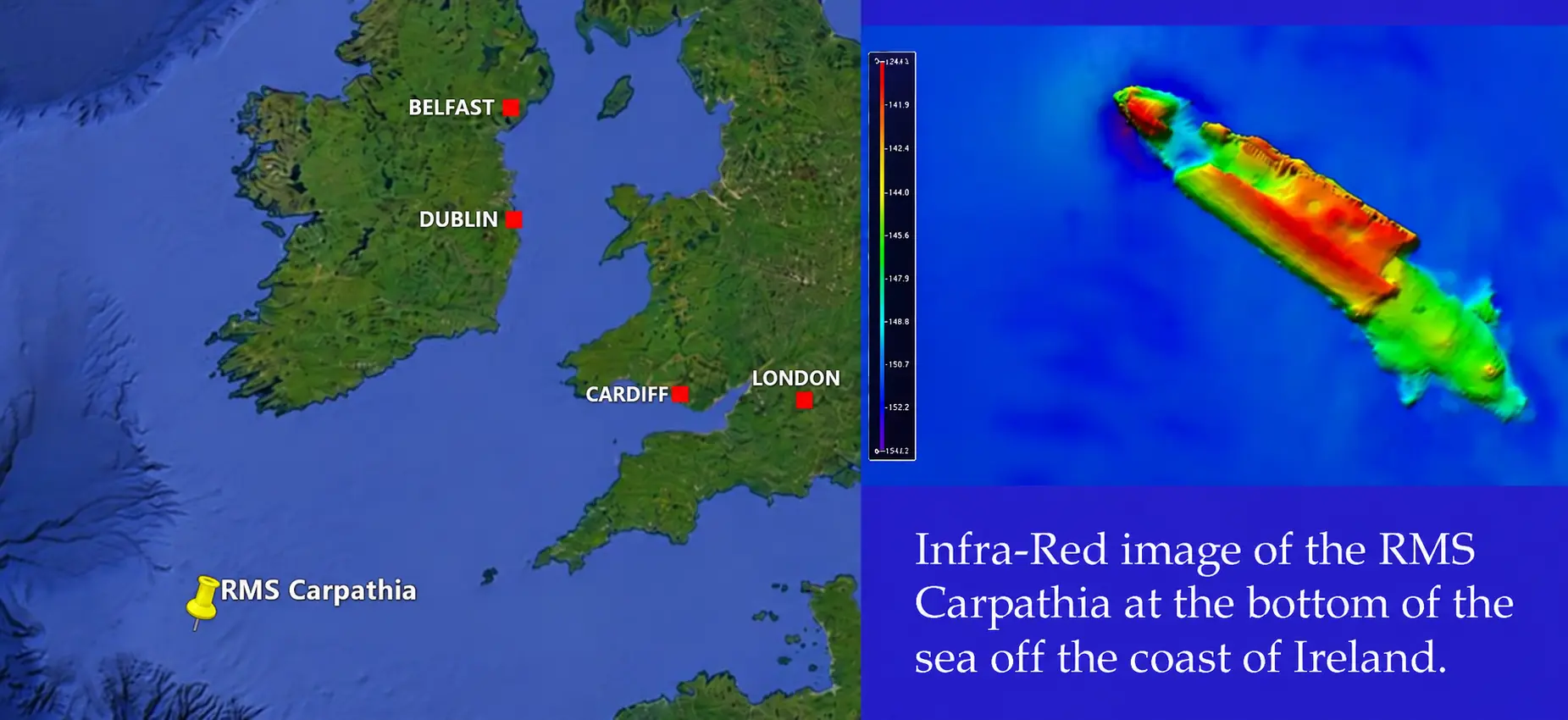
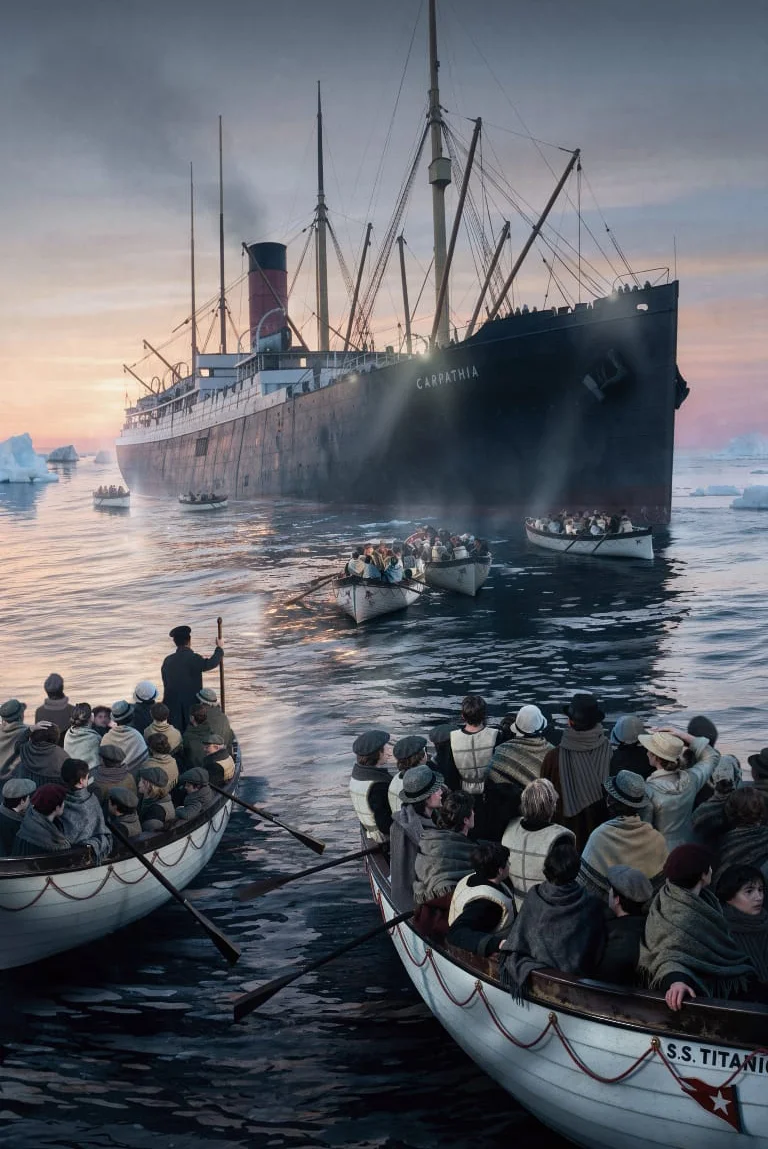
The expedition is planned for August 2027
Next August, the plan is to embark on a 21-day scientific expedition from Cobh, Ireland, aimed at recovering artifacts for research and education before the ocean claims them forever. This mission will bring Carpathia’s legacy back to life.
Departure: Cobh, Ireland
Planned duration: 21 days
Status: expedition in planning
Documentary: filming the mission and its preparation
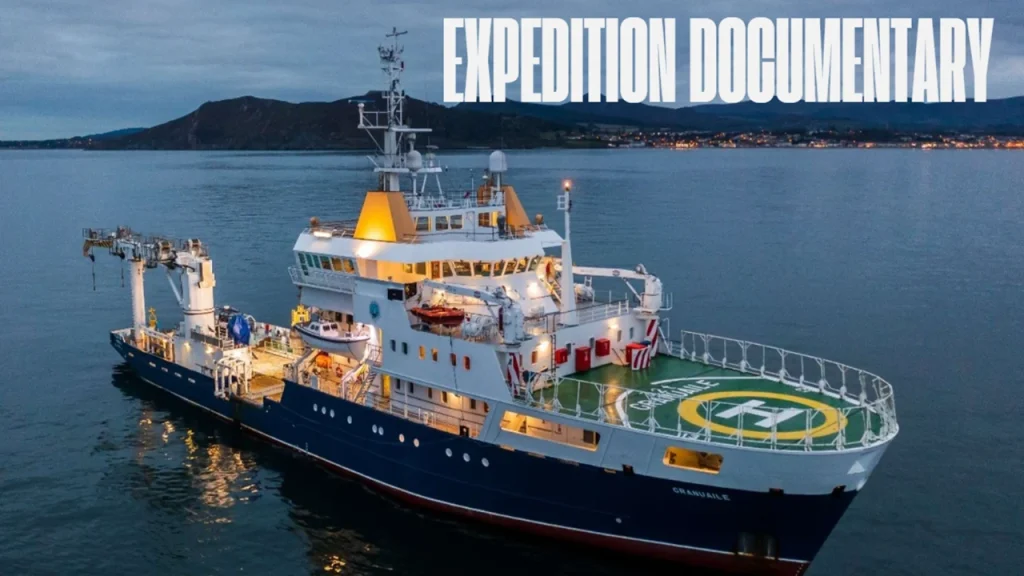
Expedition vessel presentation from Carpathia Productions. Vessel negotiations are ongoing.
The four pillars of the expedition are:
01 / DOCUMENT
Site Mapping: A comprehensive ROV-based 3D scan of the wreck, using the same advanced mapping approach applied to the Titanic and Shackleton’s Endurance, to document the Carpathia’s current condition and establish a detailed baseline for monitoring its continued deterioration.
02 / RECOVER
Artifact Rescue: Systematic recovery of core historical items from inside of the wreck. For the first time in history, we are entering the wreck of the Carpathia, and our goal is to save artifacts from the ship before they are lost forever.
03 / PRESERVE
Collection Curation: Preservation of a collection for upcoming global exhibitions.
04 / SHARE
Media Archiving: Real-time 4K/8K recording of the recovery process for the expedition documentary for present and future generations to see.
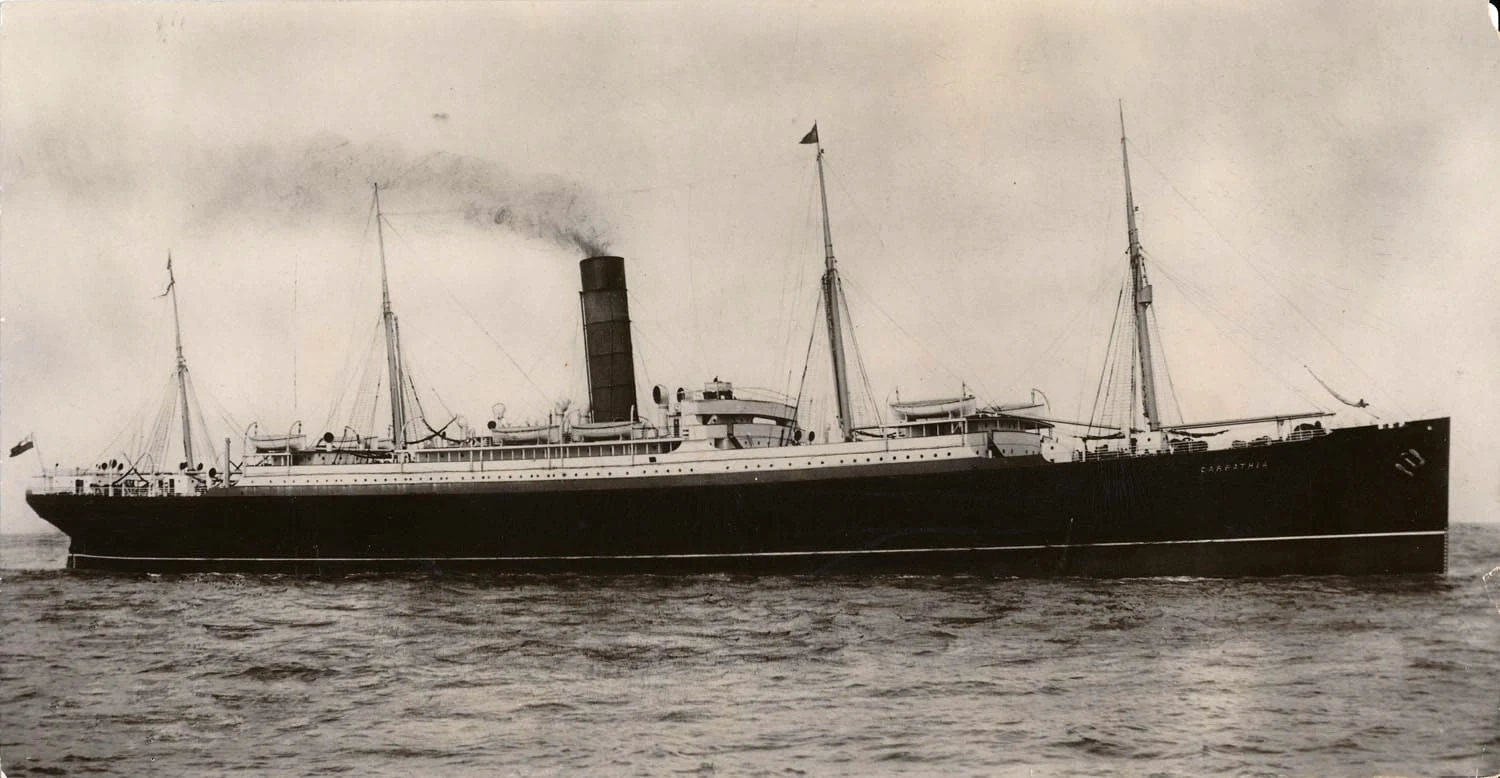
Documentary of the Expedition and the history of the CARPATHIA
The documentary will connect the ship’s history with the modern challenge of working on a deteriorating wreck. Preparation, exploration and conservation form the next chapter of the story.
Speak with the expedition team ↗︎THE PREVIOUS EXPEDITIONS
The wreck has been explored only twice, in 2000 and 2007.
The First Dive Expedition took place in 2000. This team captured the very first video footage of the wreck, confirming it was resting completely upright on the ocean floor. During this initial dive, researchers recovered several artifacts, including a china plate featuring the official Cunard Line crest, providing undeniable proof of the ship's identity.
The Second Dive Expedition was in 2007; the site was explored a second time by a dedicated team of technical deep-sea divers. They successfully recovered the ship's double-headed bridge telegraph and noted that portions of the overhead superstructure were beginning to cave in on themselves.
Our expedition is slated for August 2027. We must act quickly as the ship faces severe structural decay due to immense depth and bacteria.
We are excited to bring together state-of-the-art underwater technology with world-renowned scientists and explorers who will help write the next chapter of the Carpathia and establish once and for all that she was not simply the ship that rescued the passengers of the Titanic, but was one of the most remarkable immigrant ships and humanitarian symbols in maritime history.
We are in negotiations with potential ships that will perform the duties necessary for a successful expedition.
Our documentary crew will be filming every phase of the expedition.
ROV TEAM & the AUV Operators
First to go to the site will be the ROV Team to do the first 3D scan of the wreck in history. Its mission is to make the 3D scan, scan the area, verify the exact wreck location, and map hazard before humans dive. Approximately 150,000–300,000 overlapping high-resolution images, supplemented by laser and sonar data, will be required to produce a comprehensive 3D digital model of the wreck and surrounding debris field.
The ROV is equipped with sonar and high-resolution cameras will navigate the darkness to map sections of the ship that are otherwise impossible to view simultaneously.
What we know:
Physical damage matches historical accounts of the three German torpedo impacts from the U-boat U-55 in 1918.
Over a century of deep-sea currents has taken its toll. The ship's four masts, iconic single funnel, and wooden deck superstructures have entirely collapsed.
The wreck is heavily shrouded in tons of commercial fishing nets snagged on the hull over the decades. These nets pose a severe entanglement risk to both divers and robotic submersibles.
Despite the upper deck collapse, the lower hull remains a time capsule. Expeditions confirmed that many of the original portholes and lower gangway doors are perfectly intact. These are the exact entry points that traumatized Titanic survivors saw as they were rescued
TECHNICAL & SATURATION TEAMS
The next to go down will be the Technical & Saturation Teams
Each team will prepare their part of the site, securing mooring lines to the wreck and setting up underwater work stations.
Technical Divers (10 Crew): They are agile, unmored deep-sea scouts and will capture high-quality media.
Executing exploratory sweeps and rapid imaging (15–20 min bottom time; 4-hour decompression cycle).
We are proud that our expedition includes some of the finest technical divers in the world. The leader of our technical diving team is Richard Stevenson, who participated in the 2007 expedition to the Carpathia, during which a small number of artifacts were successfully recovered. His experience and knowledge of this wreck are invaluable to our project. I too will be part of this team, 10 technical divers in total.
Saturation divers
The second team consists of six saturation divers, who will work eight hours a day to recover artifacts from the wreck. Once brought to the surface, the artifacts will be thoroughly examined by marine archaeologists, then sorted, labeled, and placed in fresh water to begin the desalination process.
The documentary begins with:
1) The Expedition and the preparation to recover artifacts of the RMS Carpathia.
The CARPATHIA Expedition Documentary will include the following:
A team of SATURATION DIVERS (for recovering artifacts from the wreck)
A team of TECHNICAL DIVERS (for filming the wreck for the documentary)
Securing a research or dive vessel, complete with crew (four weeks)
Deep-Sea Equipment: Deploying multibeam sonar, Remotely Operated Vehicles (ROVs), or crewed submersibles requires hundreds of thousands of dollars in dedicated hardware, fuel, and technical personnel.
Specialized Cameras: Underwater camera rigs, ruggedized lighting, and certified waterproof housings capable of withstanding ocean depths are a massive line item, extensive visual effects (VFX), 3D mapping
Logistics & Permits: Securing maritime permits, complying with underwater archaeology regulations, and accommodating scientists and historians significantly add to pre-production costs.
The narrative quickly shifts to the year 2000 in the murky waters off the coast of Ireland.
The Search: Marine explorer Clive Cussler and his team battle fierce Atlantic storms.
The Find: Scan sonar locates the fragmented remains resting upright on the seabed.
The Condition: The hull is collapsing, creating an urgent race against time.
EXPEDITION DOCUMENTARY / PART II
A brief retelling of the history of the ship:
- On May 5, 1903, the SS (Steamship) Carpathia was launched departing from Liverpool, England, and traveling to Boston, designed primarily as an unglamorous intermediate ship for second- and third-class/immigrant passengers rather than luxury travel.
- In 1905, she underwent a major renovation to add first-class quarters and expand total capacity and began carrying mail changing her designation to the RMS Carpathia. It is in this period that she rescued the passengers of the Titanic on April 15, 1912.
The Call: Captain Arthur Rostron intercepts the Titanic’s distress signals.
The Dash: Carpathia navigates dangerous ice fields at record speed.
The Rescue: The crew brings 716 survivors aboard. Four die during the return voyage; 712 arrive safely in New York.
Returning to receive well-deserved awards and accolades
Starting in 1914–1915, Carpathia served as HMT Carpathia, transporting Allied forces including the Canadian Expeditionary Force across the Atlantic. She also continued commercial passenger and cargo operations for the Cunard Line.
- On July 17, 1918, the Carpathia was tragically torpedoed and sunk by a German U-boat .
EXPEDITION DOCUMENTARY / PART III
The core of the film focuses on the dangerous logistics of recovering artifacts from a crumbling wreck.
The Strategy: Teams use heavy-duty ROVs instead of human divers due to extreme depth and currents.
The Challenges: Decaying fishing nets wrap around the ship, threatening to trap the equipment.
The Breakthrough: Precision robotic arms successfully retrieve personal items and ship fixtures.
The Preservation: Onboard scientists immediately submerge findings in chemical baths to prevent rapid decay.
The documentary concludes in a conservation lab, connecting recovered items back to the descendants of the crew and survivors. By bringing these physical pieces of history to the surface, the film ensures that the Carpathia is no longer remembered simply as a footnote to the Titanic tragedy but as a symbol of ultimate heroism.
The expedition to find the Carpathia will be documented in a one-hour documentary film.
PLANNED / AUGUST 2027
We have the support of RMS Titanic Inc. for Carpathia Productions’ plans for the recovery and exhibition of artifacts.
The mission is planned for 21 days from Cobh, Ireland. The documentary preparation includes a four-week vessel charter. Vessel negotiations, permits and logistics remain part of the project’s planning. The expedition documentary is planned as a one-hour film.
KEEP THE STORY ALIVE / #BECOTTAM
Connect with the team about research, technical collaboration and expedition support.
LET’S TALK↗︎